
AI In Practice
AI in Practice — Software isn’t finished when it works
AI comes up in almost every conversation we have with clients these days, so we thought we’d share…
Enterprise software. Since 1993.
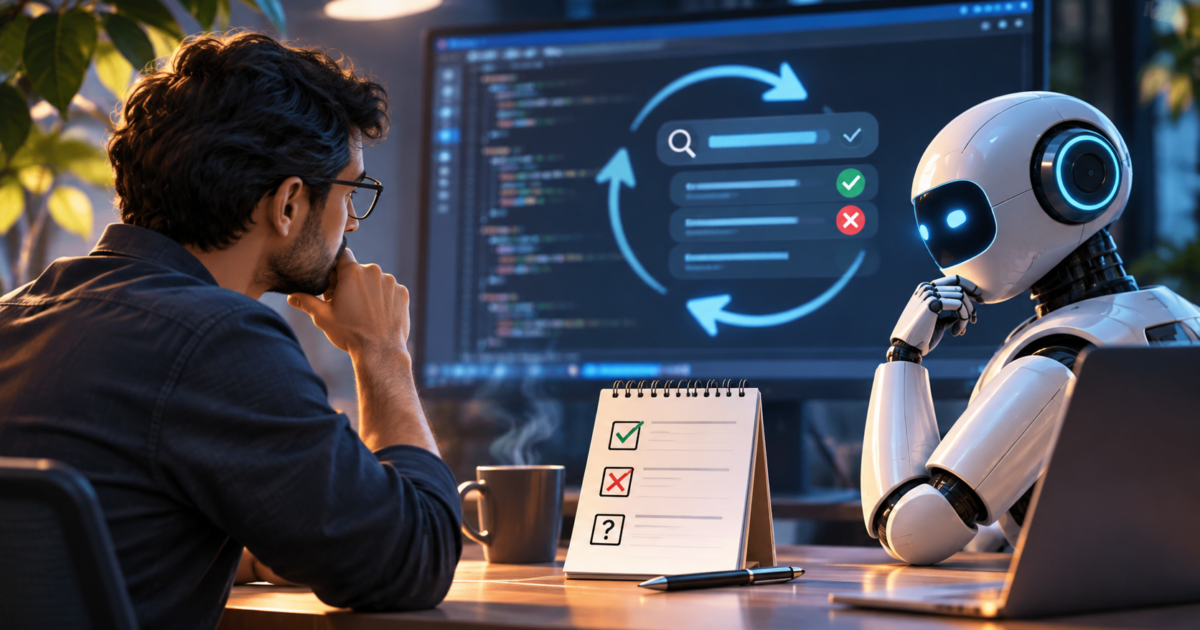
During a recent development task, I found myself repeatedly asking an AI coding assistant to stop investigating and reconsider its approach. We were troubleshooting an issue in an existing application. The assistant examined the code, ran diagnostics, and proposed possible explanations. When one didn’t hold up, it moved to another. Then another.
Each step seemed reasonable on its own. But after several rounds, we weren’t any closer to understanding the problem.
What concerned me wasn’t that the assistant was getting things wrong. That’s part of debugging.
It was that the assistant kept working without recognizing that its investigation wasn’t making progress.
Human engineers fall into this trap too. The difference is friction. AI can search code, run checks, and generate new hypotheses in seconds. What might otherwise prompt someone to reconsider the approach can become another round of automated investigation.
And because every step looks productive, it’s easy to mistake activity for progress.
I eventually stopped the investigation and asked the assistant to reconsider what it actually knew, rather than what it thought might be happening. Once it separated what it had verified from what it had inferred, the premise it had been building on turned out to be unchecked.
That experience changed how I approach AI-assisted debugging.
Now, after two rounds that haven’t established a new fact or ruled out a meaningful possibility, I make the assistant stop and answer three questions before continuing:
1. What is confirmed? Only what we’ve directly verified, not inferred or assumed.
2. What have we ruled out? What the investigation has genuinely eliminated.
3. What would prove the current theory wrong? If we can’t name evidence that would, we’re not testing a hypothesis. We’re defending an explanation.
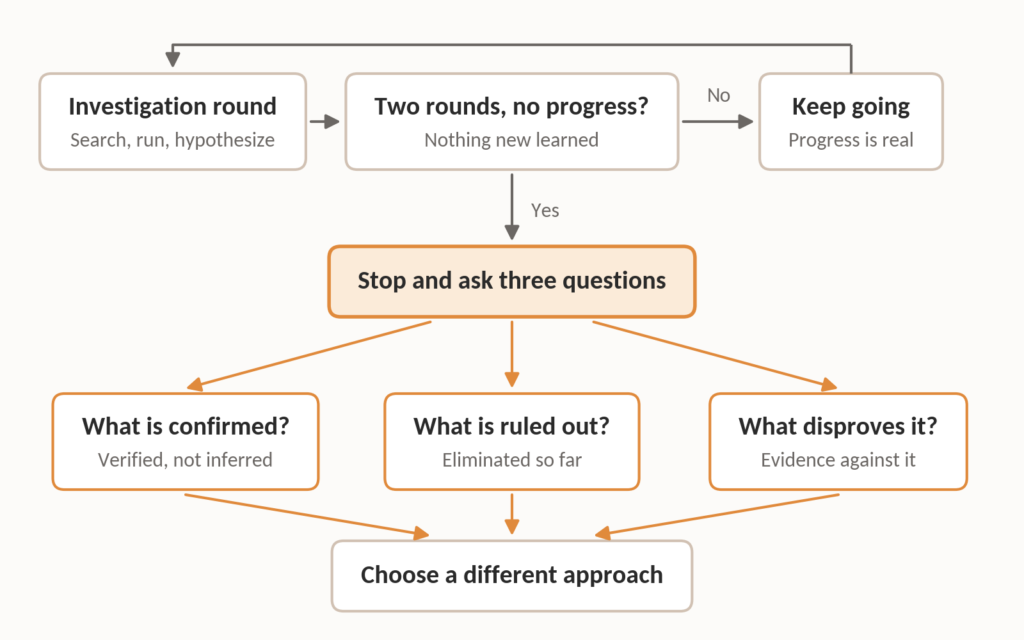
The objective isn’t to limit how much AI can investigate. It’s to ensure that each investigation reduces uncertainty rather than generating another plausible explanation.
One question worth asking this week
When your AI assistant spends twenty minutes investigating a problem, can it tell you what it knows now that it didn’t know twenty minutes ago?
If it can’t, perhaps the next step isn’t another diagnostic. It’s questioning the assumptions behind the investigation.
If you’ve experienced something similar, I’d genuinely love to hear about it. Just reply.
More like this
AI In Practice
AI comes up in almost every conversation we have with clients these days, so we thought we’d share…

AI In Practice
An AI assistant in a financial app I was building told me I already owned 250 shares at…
AI In Practice
With conventional software, a rule is a rule. If a condition says not to execute a particular path,…