

AI is transforming how organizations work. Employees are using AI assistants to write code, summarize documents, analyze data, automate workflows, and make faster decisions. As AI becomes part of everyday business operations, organizations are handling more sensitive information through AI systems than ever before.
This shift has introduced new privacy and security challenges. Unlike traditional applications, AI systems process natural language, retain conversational context, interact with multiple data sources, and generate insights from large volumes of information. Prompts, uploaded documents, conversation history, and AI-generated responses can all contain confidential business data or personal information that must be protected.
At the same time, regulators and customers are placing greater emphasis on responsible AI. Organizations are expected not only to safeguard sensitive information but also to demonstrate how AI systems collect, process, store, and govern that data. Privacy has become a fundamental part of building trustworthy AI.
In this article, we’ll explore how AI is changing the definition of sensitive data, the emerging risks organizations face, and the practical steps businesses can take to protect information throughout the AI lifecycle.
AI Has Redefined Sensitive Data
Traditional definitions of sensitive data focused on personally identifiable information, financial records, healthcare information, and government-issued identification. In the age of AI, that definition has expanded significantly.
Modern AI environments generate entirely new categories of valuable information, including AI prompts, conversation histories, model inputs, embeddings, behavioral analytics, biometric authentication data, training datasets, and AI-generated insights. Even when these datasets do not explicitly contain personal information, they can reveal confidential business strategies, customer behavior, proprietary algorithms, or intellectual property when analyzed collectively.
Consider a financial analyst using an enterprise AI assistant to summarize quarterly reports or a software engineer asking a coding assistant to troubleshoot proprietary source code. Without appropriate governance and security controls, confidential information can unintentionally become part of AI processing pipelines or be exposed through external AI services. Organizations must therefore redefine what constitutes sensitive information and extend their security policies to cover every interaction with AI.
Securing the AI Data Lifecycle
Protecting information requires visibility across every stage of the AI data lifecycle rather than focusing only on storage or access controls.
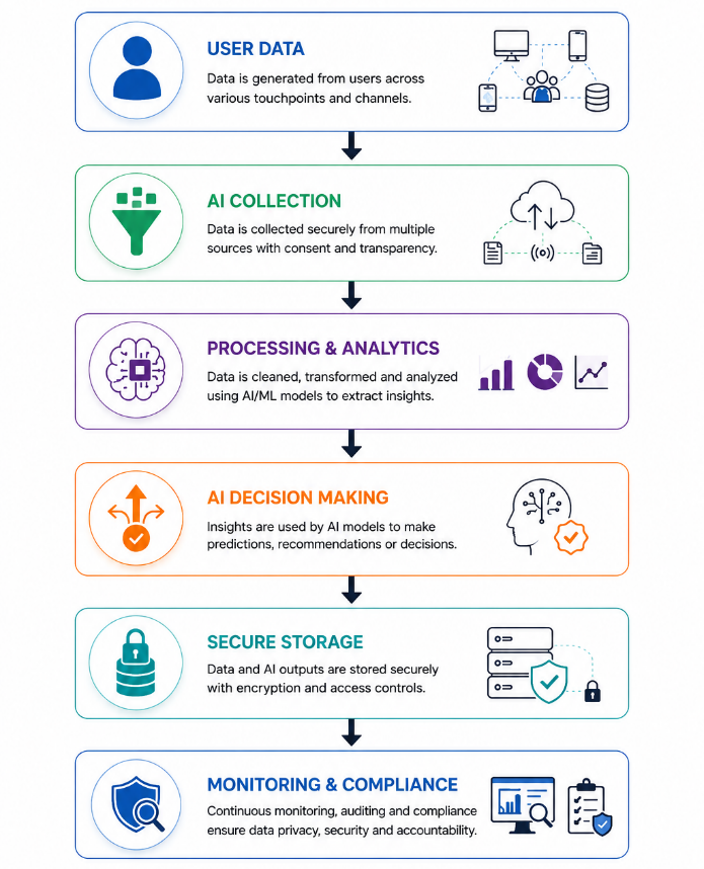
Data is first collected from users, enterprise applications, connected devices, and business systems. During processing and analytics, AI models transform raw information into insights, predictions, and recommendations. These outputs often influence business decisions, making transparency and explainability increasingly important. The resulting information is then stored for future use while monitoring and governance processes continuously validate compliance, detect anomalies, and reduce operational risk.
Securing each phase of this lifecycle ensures that privacy is embedded into AI systems from the moment data is collected until it is securely archived or deleted. Organizations that adopt lifecycle-based security are better positioned to maintain compliance, improve operational resilience, and build long-term trust in enterprise AI.
The Growing AI Threat Landscape
Cybercriminals are evolving as rapidly as AI technology itself. Generative AI enables attackers to produce highly convincing phishing emails, deepfake voice messages, fake identities, and sophisticated social engineering campaigns at unprecedented scale. New attack techniques such as prompt injection, model manipulation, and AI-assisted malware development continue to expand the enterprise threat landscape.
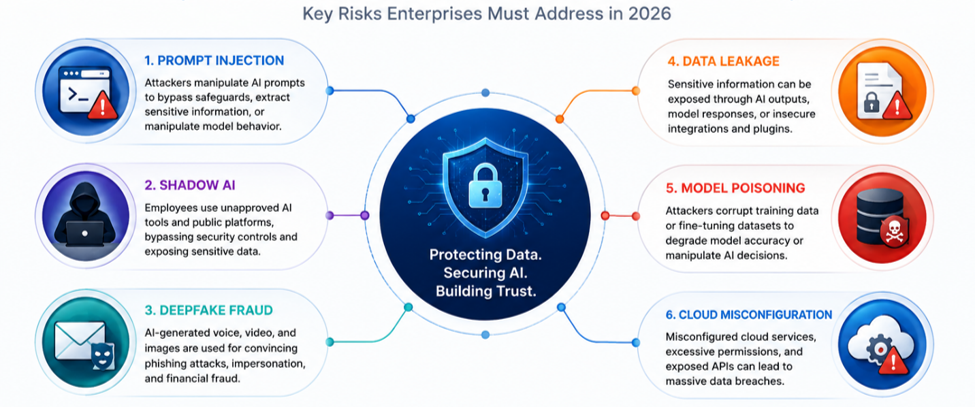
Internal risks are growing as well. Employees frequently use public AI platforms to summarize documents, generate code, or analyze spreadsheets without realizing that sensitive information may be retained or processed outside organizational controls. This phenomenon, commonly referred to as Shadow AI, has become one of the fastest-growing enterprise security concerns because it bypasses governance, monitoring, and data protection policies.
The widespread adoption of cloud services further increases complexity. Organizations now operate across multiple AI platforms, SaaS applications, APIs, and cloud providers. A single misconfigured storage repository, excessive permission, or insecure AI integration can expose thousands of sensitive records within minutes. Effective AI security therefore requires continuous visibility, automated monitoring, and proactive risk management across increasingly complex digital environments.
Privacy Has Become an AI Governance Challenge
Privacy can no longer be managed independently of AI governance. Organizations must answer new questions that did not exist only a few years ago:
- Is customer information being used to train AI models?
- Which AI systems have access to confidential business data?
- Can employees safely use public generative AI services?
- How long should AI conversations be retained?
- Can AI-driven decisions be explained, audited, and challenged?
These questions sit at the intersection of privacy, governance, compliance, and responsible AI. Leading organizations are embedding privacy into every stage of AI development through Privacy by Design, human oversight, explainable AI, risk assessments, and continuous compliance monitoring. Rather than treating compliance as a regulatory exercise, they are integrating AI governance into everyday business operations.
Before Deploying an AI Application: A Practical Privacy Checklist
Understanding AI governance is only the first step. Before adopting any AI application whether it’s a public chatbot, coding assistant, document summarizer, or enterprise AI platform organizations should verify how the service handles their data.
Ask these questions:
- Where are prompts stored?
Can you identify whether prompts are stored locally, in your cloud environment, or on the AI provider’s infrastructure? - Are prompts used for model training?
Does the provider use customer prompts to improve its AI models, or can training be disabled? - Who has access to prompts and responses?
Are conversations accessible only to authorized employees, or can vendors and support personnel also view them? - How long are prompts retained?
Is there a documented retention period that aligns with your organization’s data governance policies? - Can prompts and conversation history be deleted?
Can users permanently remove prompts, uploaded files, and AI conversation history when required?
Building a Privacy-First AI Strategy
Protecting sensitive information in AI-powered environments requires a balanced combination of technology, governance, and people.
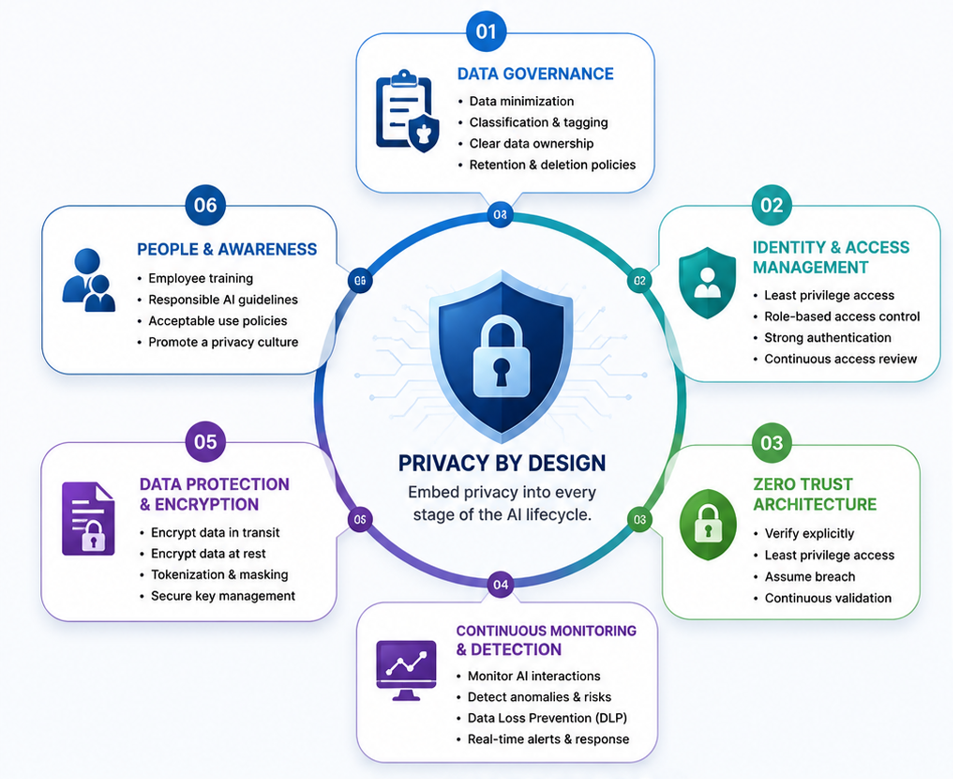
Organizations should begin by adopting data minimization principles, ensuring AI systems only access information necessary for specific business purposes. Strong identity and access management, encryption, Zero Trust architectures, and Data Loss Prevention controls help prevent unauthorized access while reducing the impact of potential breaches.
Continuous monitoring has become equally important. AI-powered security platforms can identify abnormal user behavior, detect insider threats, classify sensitive information, and respond to incidents before they escalate. At the same time, organizations must invest in employee awareness programs that educate users on the responsible use of AI tools, safe handling of confidential information, and recognition of AI-generated phishing or deepfake attacks.
A successful AI security strategy combines technical safeguards with governance frameworks that continuously evaluate AI risks, maintain regulatory compliance, and support responsible innovation.
AI Is Becoming the Defender
While AI introduces new privacy risks, it is also transforming cybersecurity defenses. Modern security platforms use AI to automate threat detection, classify sensitive information, identify unusual behavior, prioritize alerts based on business impact, and accelerate incident response. Instead of manually investigating millions of events, security teams can focus on high-risk incidents requiring human expertise.
AI also strengthens privacy operations by identifying personally identifiable information, monitoring compliance requirements, detecting unauthorized data movement, and improving governance across hybrid and multi-cloud environments. However, AI should augment—not replace—human judgment. Human oversight remains essential for validating AI decisions, investigating complex incidents, and ensuring ethical and regulatory compliance.
Preparing for the Future of AI Data Protection
The conversation around data privacy has fundamentally changed. Protecting sensitive information is no longer limited to preventing data breaches—it now requires managing how intelligent systems collect, process, analyze, store, and use information throughout the AI data lifecycle.
Organizations that embed Privacy by Design, Responsible AI principles, and strong AI governance into every stage of their digital transformation will be better positioned to innovate securely while maintaining customer trust. Those that continue treating privacy as a compliance checkbox risk falling behind evolving regulations, emerging cyber threats, and growing customer expectations.
As AI continues to reshape every industry, trust will become one of the most valuable competitive advantages. Organizations that protect sensitive information, secure enterprise AI, and govern data responsibly will not only reduce cyber risk but also create a stronger foundation for sustainable innovation and long-term business success.