
Uncategorized
The Futility of Endless AI Reviews: Why AI Reviews Never Feel Finished
I think many of us are using LLMs the wrong way. Not because the tools are bad. Because…
Enterprise software. Since 1993.

Blue-Green, Canary, Rolling, A/B, Shadow, and Recreate Deployments
As microservices become central to modern application delivery, deployment strategy plays a critical role in maintaining availability, reducing release risk, and protecting customer experience.
For example, if an online banking application is updated during peak business hours, a deployment issue could prevent customers from logging in, making payments, or transferring funds, directly affecting customer trust, revenue, and reputation.
As organizations adopt cloud-native architectures and microservices, software is released more frequently, sometimes dozens or even hundreds of times per day. Deployment reliability therefore becomes as important as application development itself. Modern deployment strategies help teams introduce changes incrementally, observe real-world behavior, and respond quickly when unexpected issues arise.
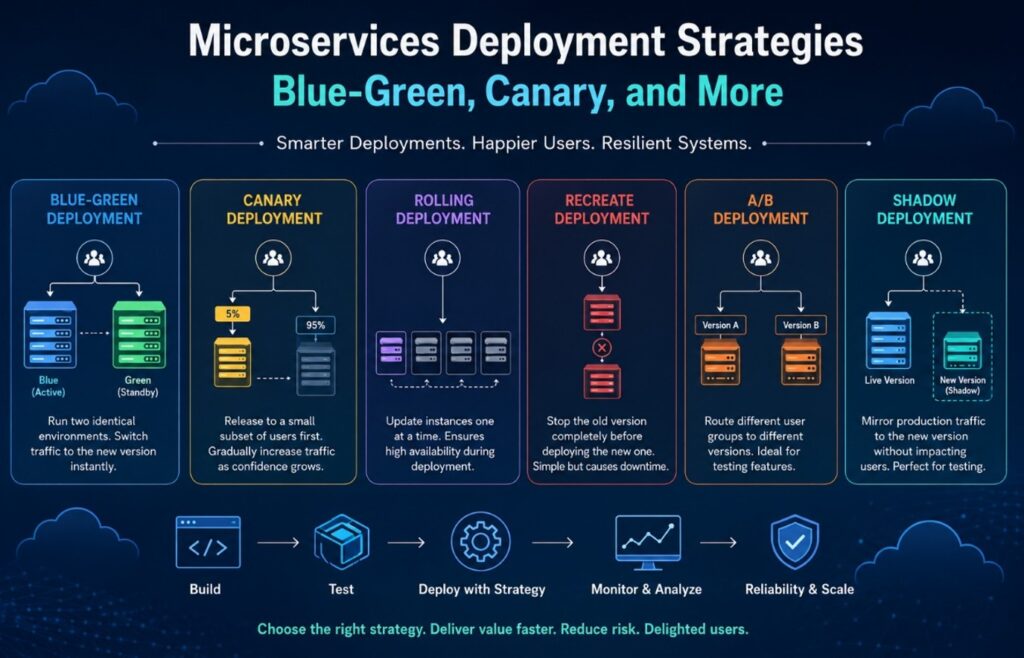
Blue-Green Deployment maintains two production environments. The Blue environment serves the current live version, while the Green environment hosts the new version for validation. Once the new release is verified, traffic is switched from Blue to Green. If a problem is detected, traffic can be redirected to Blue, providing a fast rollback path. The main trade-off is the additional infrastructure and operational cost of maintaining two comparable environments.
Canary Deployment introduces a new application version to a small percentage of users before expanding the rollout. Teams can monitor errors, latency, resource utilization, and business metrics while limiting the potential impact of a faulty release. If the new version performs as expected, traffic is progressively increased. This approach requires effective traffic management, observability, and continuous monitoring.
Rolling Deployment replaces application instances progressively rather than updating the entire environment at once. This keeps the application available while the new version is introduced and avoids the need for duplicate production infrastructure. It is a practical and cost-effective approach, although rollback can take longer than with Blue-Green Deployment if issues are discovered.
Recreate Deployment stops the existing application before deploying the new version. It is straightforward to implement and can be appropriate for smaller or non-critical applications where temporary downtime is acceptable. Its primary limitation is the service interruption during the deployment window.
A/B Deployment presents different application versions or features to separate user groups. Teams can compare performance, engagement, and user behavior to support data-driven decisions. Effective user segmentation and analytics are essential to obtain meaningful results.
Shadow Deployment sends a copy of live production traffic to a new application version without exposing its responses to users. This allows teams to evaluate performance, stability, and behavior using realistic workloads before the new version becomes customer-facing. The approach requires additional infrastructure and careful traffic management.
| Strategy | Downtime | Risk | Rollback | Best Use Case |
| Blue-Green | None | Low | Very easy | Major releases |
| Canary | None | Very low | Easy | Gradual feature or release validation |
| Rolling | Minimal | Medium | Moderate | Kubernetes and continuous deployments |
| Recreate | Yes | High | Moderate | Small or non-critical applications |
| A/B | None | Low | Easy | Feature experiments and user behavior analysis |
| Shadow | None | Very low | Easy | Production validation before launch |
Consider an e-commerce application running on Azure Kubernetes Service (AKS). A team can use Canary Deployment to initially route 5% of production traffic to the new application version. Azure Monitor and Application Insights can be used to observe key indicators such as application errors, latency, and resource utilization. If the release performs as expected, traffic can be progressively increased until the new version reaches 100%. If issues are detected, the rollout can be stopped and traffic redirected to the stable version, limiting customer impact.
Select a deployment approach by first clarifying the release priority: protect availability, reduce blast radius, simplify operations, validate user behavior, or test production performance safely.
There is no single deployment strategy that fits every application. The right approach depends on business criticality, downtime tolerance, rollback speed, infrastructure cost, release frequency, experimentation needs, and recovery objectives. In practice, modern DevOps teams often combine these strategies with Kubernetes, service meshes, feature flags, and observability platforms to create release processes that are resilient, measurable, and aligned with business risk.
For organizations operating cloud-native systems, the objective is not only to deploy faster but to release changes safely, detect issues early, minimize customer impact, and recover quickly when conditions change.